
Operations
8 min read
I Have Managed Operations Across 23 Countries. Here Is What Every Growing Business Gets Wrong.
Growing businesses tend to make the same five operations mistakes: treating operations as an afterthought, building systems around tools instead of processes, hiring doers before hiring a manager, assuming growth will fix operational problems, and never debriefing or measuring. Anna Rikka Aborro of TAP OBM has seen them across 18 years of operations work. The root cause: nobody owns operations.

Anna Rikka "Annikka" Aborro
Founder & CEO, TAP OBM · April 2026

After 18 years of operations management across multiple industries and more than 23 countries, I have seen the same five mistakes in every growing business I have stepped into. I have managed teams of over 100 people. I have coordinated operations across time zones, languages, and vendor relationships where nothing could fall through the cracks. Different industries. Different scales. The same five structural mistakes.
Sign item 01. Mistake 1: Treating Operations as an Afterthought

Operations is not a behind-the-scenes support function. It is the infrastructure that makes everything else work. When operations is an afterthought, the business scales on the founder's energy instead of on systems. What I do instead: I treat operations as a first-class function from day one. It gets defined, staffed, and measured.
Sign item 02. Mistake 2: Building Systems Around Tools Instead of Processes
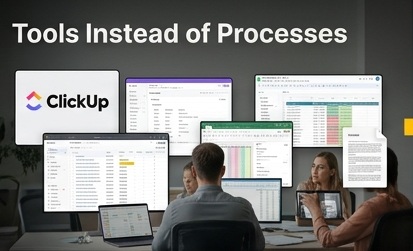
A tool is not a system. A system is a defined process with clear steps, ownership, timelines, and accountability. When you build around a tool, you reorganize every six months instead of improving operations. What I do instead: I define the process first, then find the simplest tool that supports it.
Sign item 03. Mistake 3: Hiring Doers Before Hiring a Manager
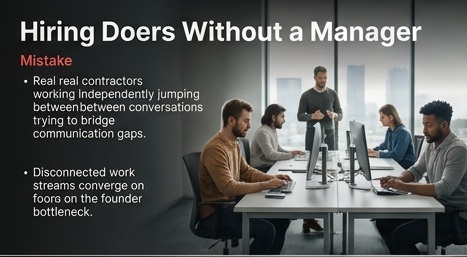
Four people doing work. Zero people managing how the work connects. Every new hire increases the founder's coordination workload. What I do instead: I make sure a management layer is in place before adding execution capacity.
Sign item 04. Mistake 4: Assuming Growth Will Fix the Operational Problems
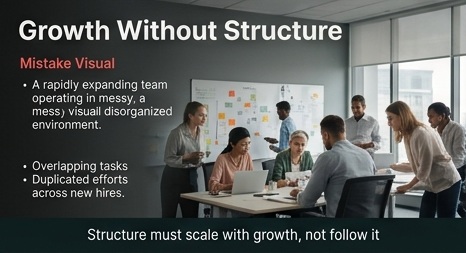
Living systems are documented processes with ownership assigned, review schedules built in, and performance indicators. At TAP OBM, every SOP includes a performance measurement section. When systems are living, new team members onboard in days. When the founder steps away, the business does not stall.
Sign item 05. Mistake 5: Never Debriefing, Never Measuring, Never Improving
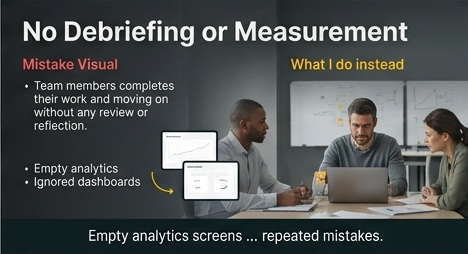
Without debriefs, the team makes the same mistakes. Without measurement, you do not know if operations are improving. What I do instead: every launch gets a structured debrief. Every process gets performance indicators. Every quarter, operational scope is reviewed.
"Intuition does not scale."
What Is the Pattern Underneath All Five Mistakes?
Nobody owns operations. That is the root cause. Every mistake is fixable with a decision: operations is a function, and someone needs to own it. That is what I built TAP OBM to do for growing online businesses.
Every TAP OBM engagement starts with an Ops X-Ray: a paid, structured deep-dive into your business before any retainer work begins. You leave with a 90-day action plan built around what we actually find.
Frequently asked questions
Should I pick a project management tool first or define my processes first?
Define the process first, then find the simplest tool that supports it. A system is a defined process with clear steps, ownership, timelines and accountability. The tool just holds it. When you build around a tool, you end up reorganizing every six months, and operations never actually improve.
What happens when a business treats operations as an afterthought?
The business ends up scaling on the owner's energy, with no systems carrying the load. Operations is the infrastructure that makes everything else work, so it cannot sit in the background as a support job. The fix: treat operations as a first-class function from day one. Define it, staff it and measure it, and make sure someone owns it.
Why does my team keep repeating the same operational mistakes?
Mistakes repeat when nobody debriefs and nobody measures. Without debriefs, the team makes the same mistakes again. Without measurement, you cannot tell whether operations are improving. Build the habit in: every launch gets a structured debrief, every process gets performance indicators, and every quarter the operational scope gets reviewed. Intuition does not scale.
Written by
Anna Rikka "Annikka" Aborro
Founder of TAP OBM. With 18+ years of operations leadership experience across 23+ countries and teams of 100+, Annikka helps established online businesses build the systems, team accountability, and operational structure they need to scale without founder dependency.
Ready to Stop Running
Your Operations Yourself?
Book a discovery call. We will talk about your business and whether TAP
OBM is the right fit before anything else.